
2026 Korea inbound tourism report · EP. 05
Hospitality insights11,000 foreign-tourist urban homestays: read the figures before choosing a property
At a glance
Korea has 11,191 operating foreign-tourist urban homestay businesses, with 63.5% in Seoul. Distinguish accommodation statistics and prepare checks before contracting.


At a glance
- August 2026 counts were 11,191 foreign-tourist urban homestay businesses nationwide and 7,108 in Seoul.
- Mapo-gu had the largest Seoul district count, at 1,997.
- Tourism accommodation businesses, urban homestays and surveyed shared accommodation are different categories.
- Supply counts alone do not establish demand or competition.
- Before contracting, ask the responsible local department whether your intended business can operate at that address.
Learn more
“More accommodation” needs a clear definition
Prospective hosts hear both “international visitors like this area” and “many new properties opened.” Map pins, OTA search results and administrative licences count different things. One business may sell several rooms, and one property may appear on several channels.
Check whether a figure counts businesses or rooms, all licensing records or currently operating businesses. This helps avoid overstating or understating local supply.
11,191 urban homestay businesses nationwide, 7,108 in Seoul
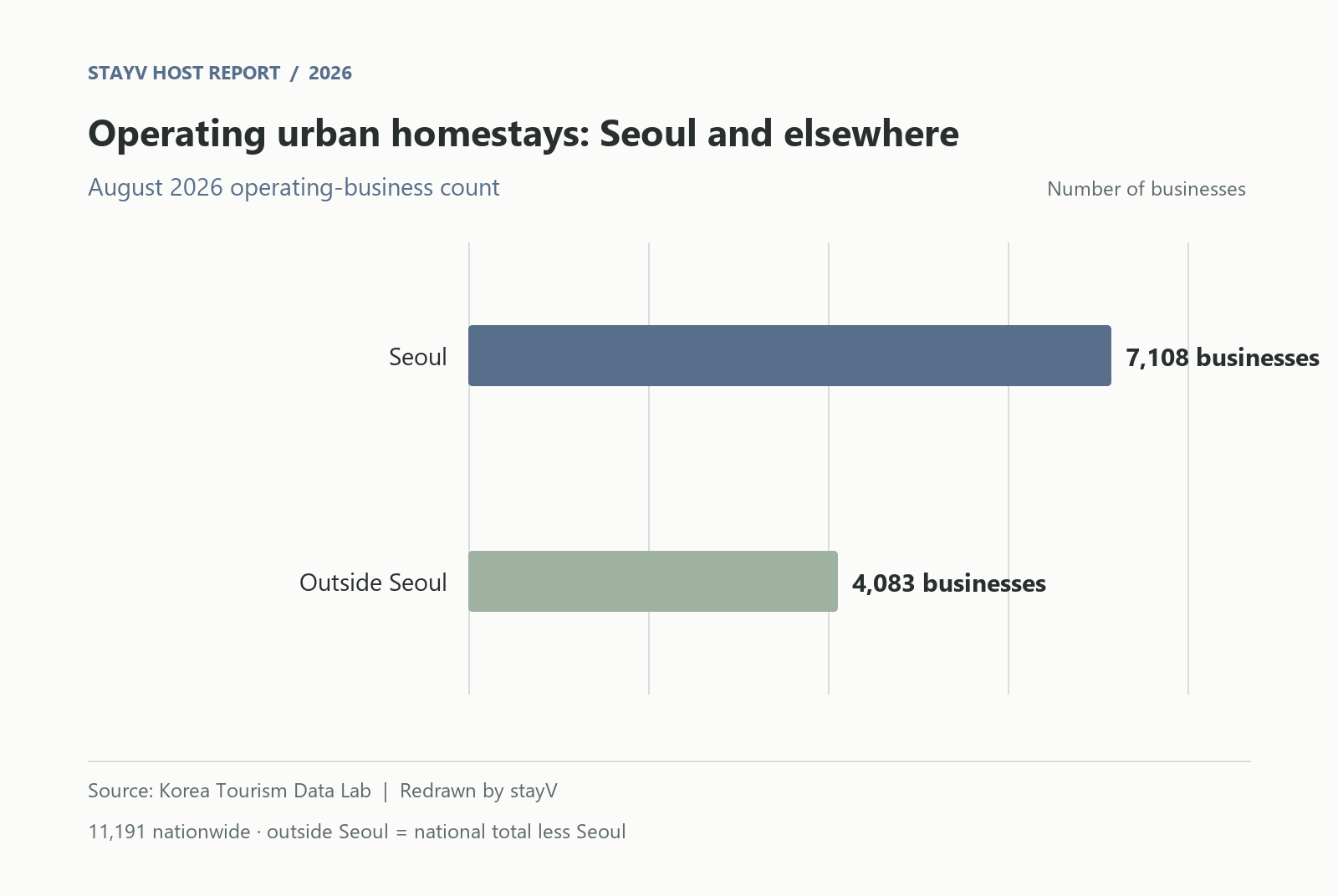
Korea Tourism Data Lab’s August 2026 operating-business data listed 11,191 foreign-tourist urban homestay businesses nationwide and 7,108 in Seoul, approximately 63.5%. The chart splits Seoul and the rest of Korea. The latter’s 4,083 is calculated by subtraction. Korea Tourism Data Lab operating status
View graph figures in a table
| Category | Value |
|---|---|
| Seoul | 7,108 |
| Areas other than Seoul | 4,083 |
These are operating businesses counted using Ministry of the Interior and Safety licensing data, not rooms for sale, available dates or revenue. Updates can change the values; Data Lab also describes a suspended-business exclusion from 2026. Differences from earlier years are therefore not presented as new openings.
Concentrated supply also gives travellers choices. Compare actual needs your property can meet, such as family space, luggage-friendly access or everyday convenience.
Distinguish tourism accommodation from urban homestays
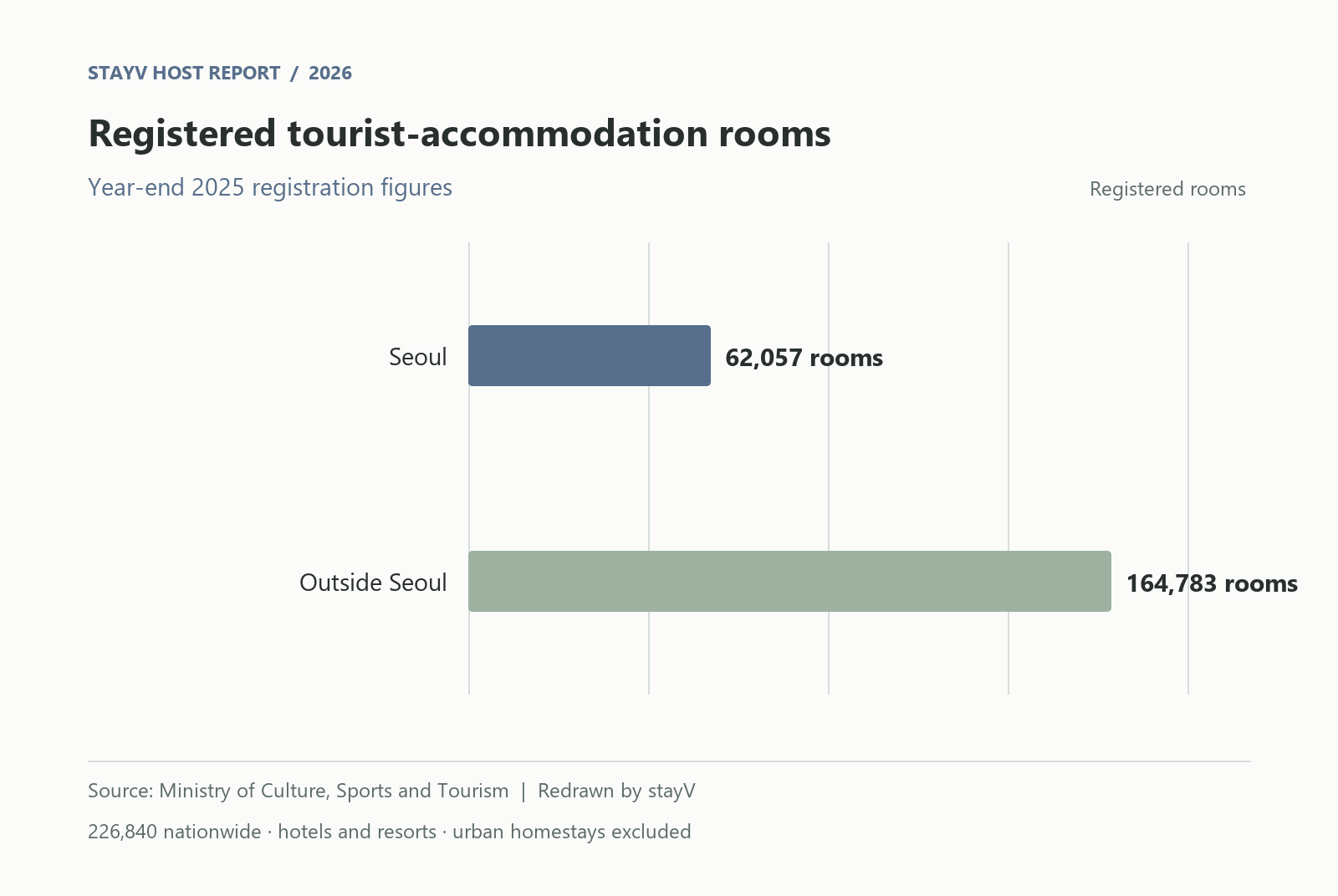
The culture ministry’s end-2025 tourism accommodation register recorded 2,996 businesses and 226,840 rooms nationwide, including 572 businesses and 62,057 rooms in Seoul. It covers hotel businesses and resort condominiums, not every accommodation category including urban homestays. Ministry tourism accommodation register
View graph figures in a table
| Category | Value |
|---|---|
| Seoul | 62,057 rooms |
| Areas other than Seoul | 164,783 rooms |
| Statistical category | Typical coverage | How to read it |
|---|---|---|
| Tourism accommodation businesses | Hotel categories including tourist hotels and hostels, plus resort condominiums | Distinguish businesses from rooms |
| Accommodation-related tourist-use facilities | Foreign-tourist urban homestays and hanok experience businesses | Review separately from tourism accommodation totals |
| Surveyed shared accommodation | What respondents identify as Airbnb, Wehome or similar stays | Does not map one-to-one to administrative categories |
| OTA search results | Properties or rooms shown on that channel | Check licensing and operating status separately |
Hanok experience businesses and Korean traditional hotels are different despite similar names. Appearance or sales channels alone do not establish the legal category. Check the address and actual building conditions.
Review Seoul’s district distribution
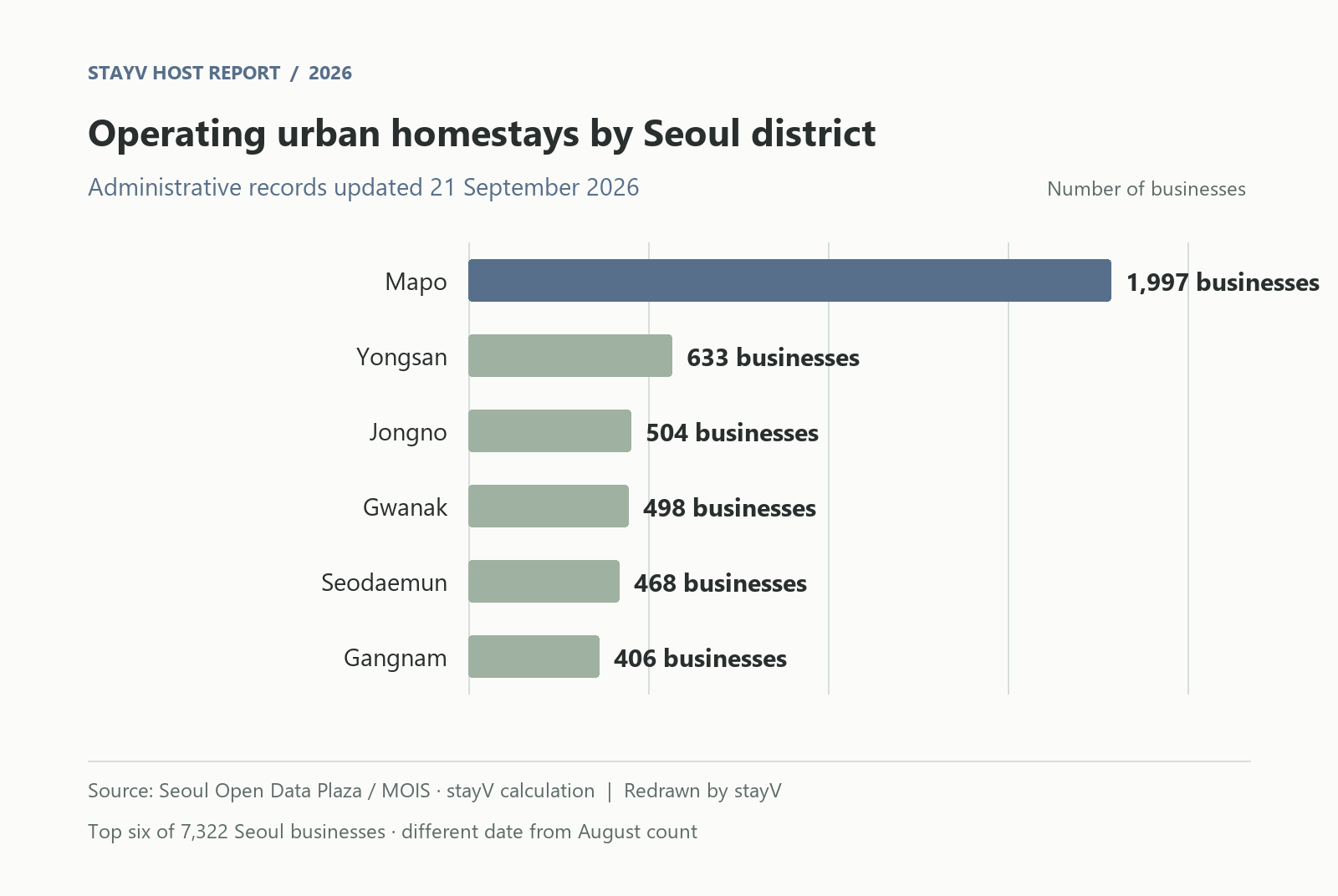
More recent daily licensing records show district distribution. Filtering the national source updated September 21, 2026 for Operating/Normal status and Seoul addresses yields 7,322 businesses. Its timing and update method differ from August’s monthly 7,108. Their difference is not treated as net new openings.
View graph figures in a table
| Category | Value |
|---|---|
| Mapo-gu | 1,997 |
| Yongsan-gu | 633 |
| Jongno-gu | 504 |
| Gwanak-gu | 498 |
| Seodaemun-gu | 468 |
| Gangnam-gu | 406 |
The chart shows the six districts with the most businesses: Mapo 1,997, Yongsan 633, Jongno 504, Gwanak 498, Seodaemun 468 and Gangnam 406. Seoul and district totals use the same filter, excluding closed and suspended records. Seoul Open Data Plaza · Interior ministry source data
Districts are large. Station access, noise, residential conditions and structures differ within Mapo too. Low supply does not prove an absence of competition; high supply does not automatically mean an area should be avoided. Use counts to frame site questions and comparisons.
Checks before contracting and during operation
Before budgeting renovations, ask the local department whether the proposed business can operate at the address. Note questions about building use, operator/residency requirements, lease permissions and safety facilities. This article does not determine registration procedures or eligibility.
Operating hosts can compare what similar properties provide and how they explain it. Public photos and amenities help, but an unavailable calendar does not prove every date is booked. Search results may not distinguish host blocks from reservations.
Record recurring questions, maintenance burdens and actual facility conditions at your property. They often identify useful improvements more directly than regional business counts.
Put established operating arrangements into stayV
After checking business conditions and deciding operating rules, communicate them clearly. Organise location, arrival, stay information, rules and FAQs in stayV, using photos for facilities and text for service arrangements.
A public guide communicates information; it does not replace licensing or guarantee bookings. Prospective hosts can check gaps in a draft, while operating hosts can manage frequently changing instructions.
Explore stayV Host · Create your first property guide · Pre-publication checks
Data basis and sources
Tourism accommodation figures use the 2025 sheet in the ministry's end-2025 register. Urban homestay figures use Data Lab's August 2026 operating data. stayV calculated Seoul districts from the September 21 licensing update, filtering Operating/Normal and Seoul addresses. Road-name addresses were used first, with lot-number addresses where absent. Individual business names, phone numbers and detailed addresses are omitted. Different source criteria and update dates prevent simple change comparisons between these totals.