
2026 Korea inbound tourism report · EP. 06
Hospitality insightsTurn tourism statistics into a practical international-guest checklist
At a glance
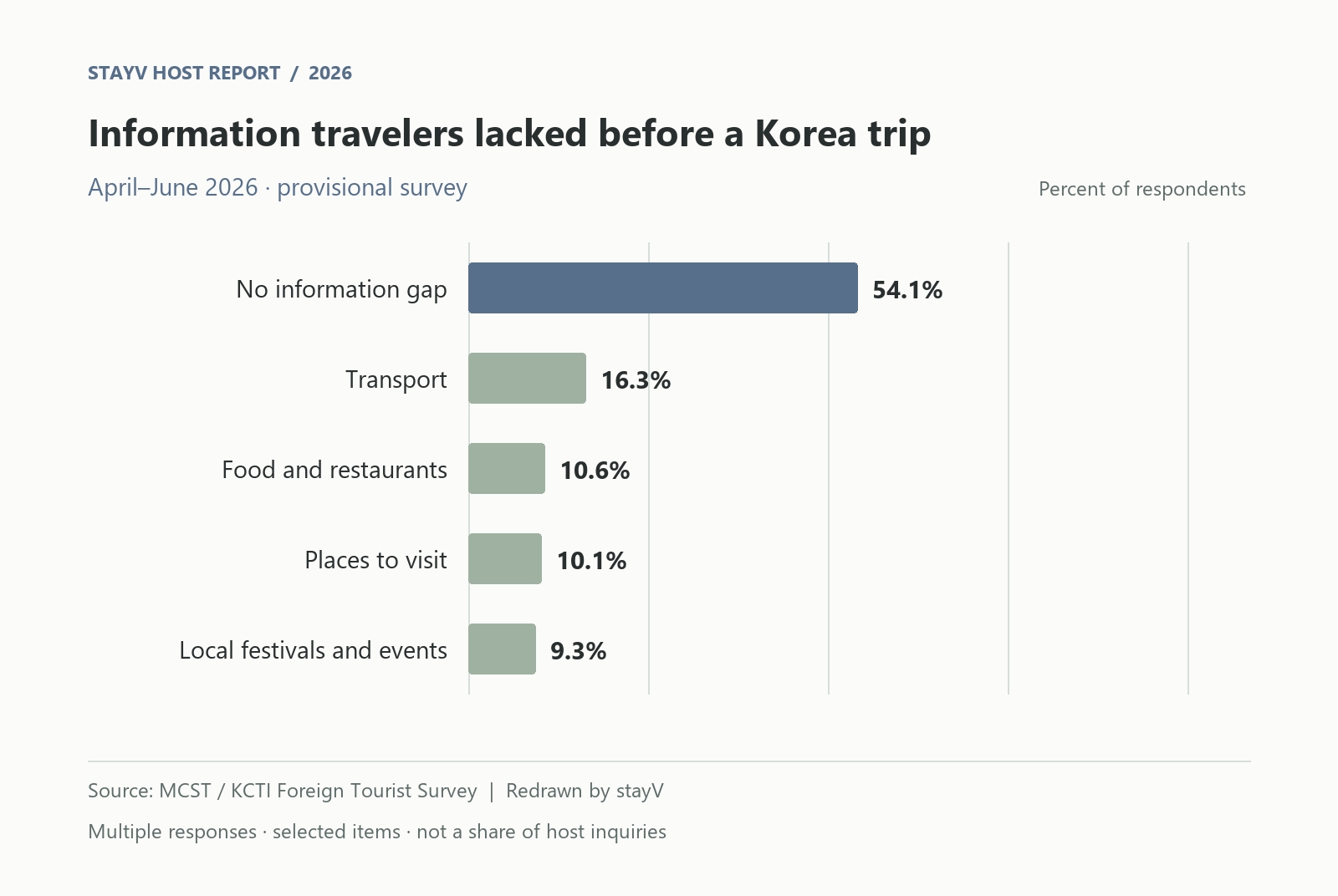
Transport, food and destinations were among information gaps during trip planning. Turn useful data topics into guidance from property selection through departure.


At a glance
- Planning information gaps included transport 16.3%, food/restaurants 10.6% and destinations 10.1%.
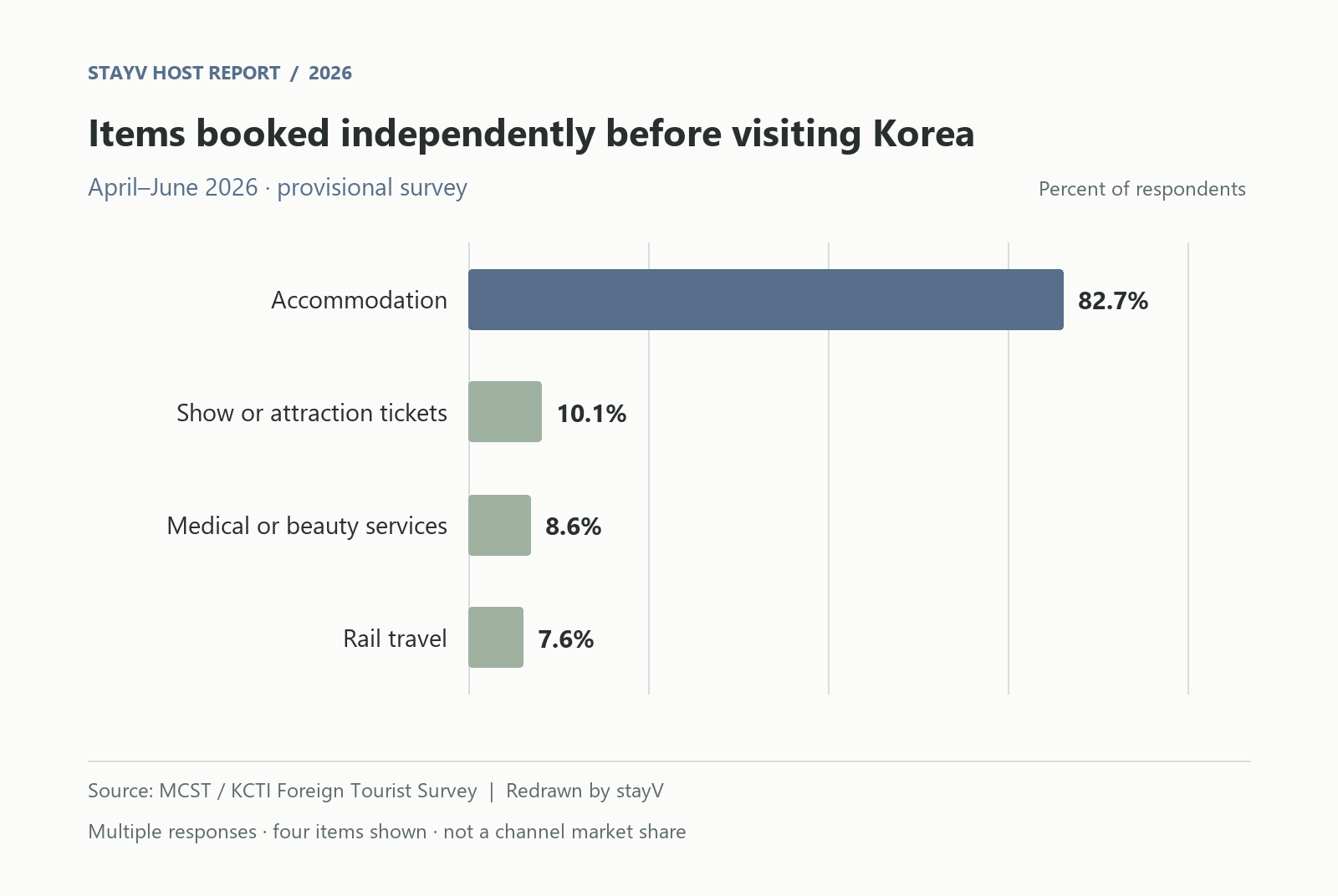
- Accommodation led independently pre-booked items at 82.7%.
- Statistics suggest topics; your guests’ questions determine priorities.
- Separate guidance for before booking, after booking, arrival, the stay and departure.
- Operating hosts can start with one repeated question; prospective hosts can draft an imaginary guest day.
Learn more
After reading the data, change one small instruction
We reviewed arrival growth, Seoul activities and accommodation. Now translate it into an action. Choose one moment guests find hard to solve alone rather than memorising every statistic.
In the provisional second-quarter 2026 International Visitor Survey, 54.1% reported no missing Korea-related information during planning. Gaps included transport 16.3%, food/restaurants 10.6%, destinations 10.1% and local festivals/events 9.3%. Not everyone experienced difficulties, but these are concrete areas where hosts may help. Original visitor survey
View graph figures in a table
| Category | Value |
|---|---|
| No information was lacking | 54.1% |
| Transportation | 16.3% |
| Food and restaurants | 10.6% |
| Places to visit | 10.1% |
| Local festivals and events | 9.3% |
This did not measure questions asked of hosts. Use it for possible topics and confirm priorities with actual guests. A low national response share can still deserve attention when it repeatedly causes trouble at your property.
Separate information from selection to arrival
The same survey reported accommodation at 82.7% among independently pre-booked items, followed by performance/admission tickets 10.1%, hospital/beauty 8.6% and rail 7.6%. These are multiple responses, not booking-channel shares or conversion rates.
View graph figures in a table
| Category | Value |
|---|---|
| Accommodation | 82.7% |
| Performance/viewing tickets | 10.1% |
| Hospital/Beauty | 8.6% |
| Rail travel | 7.6% |
Someone choosing accommodation needs location advantages and drawbacks, capacity, facilities and operating conditions. A booked guest needs practical arrival and living instructions. Separating these stages prevents important details being buried in a lengthy introduction.
| Guest stage | Information to prepare first | Host check |
|---|---|---|
| Before choosing | Location, facilities, stairs, parking and check-in conditions | Do photos and text match what is provided? |
| After confirmation | Main route and how to confirm arrival time | Has guidance reached the intended guest? |
| Just before arrival | Entrance, entry sequence and contact method | Does protected information open for the right person and time? |
| Arrival day | Wi-Fi, heating/cooling, hot water and essentials | Are common functions explained first? |
| During the stay | Laundry, rubbish, food and groceries | Are locations and hours recently checked? |
| Before departure | Check-out requirements, luggage and airport travel | Are promises limited to what you can provide? |
Operating hosts: start with one set of conversations
If you sent the same answer more than once, review that question. Was information absent, hard to find or difficult to understand? Each needs a different fix.
Add missing information, change titles or placement for findability, and rewrite confusing explanations in action order. A card called “Raise the room temperature” is easier to follow than a Heating card containing lengthy cautions for several appliances. Show actual controls in your own photos.
Lightly track whether questions recur after the change. If they do, check whether guests received the link and could open it when needed. Visits and question counts alone do not prove an effect; review how guidance worked in the same situation.
Prospective hosts: rehearse operations with a guide draft
Before your first booking, describe an imaginary guest’s day: leaving the airport, reaching the door, showering, sleeping, then doing laundry and going out. Writing the sequence reveals undecided operating arrangements.
“Ask for more towels” requires deciding who provides them, when and how many. “Late arrival is fine” requires a prepared entry method and contact availability.
While comparing candidate properties, draft arrival and living instructions. This reveals constraints such as stairs or noise that words can explain but cannot remove. Verify them before deciding what stay you can offer.
Move information into stayV in this order
Start with property basics, then add routes and entrance photos in Arrival. Use Stay information for times and everyday needs, Amenities for appliance instructions, and Rules/FAQ for operating arrangements and recurring questions.
After preparing supported languages, recheck times, prices, appliance names and places. A visible translation does not guarantee accuracy. Because information differs by disclosure level, check exact locations, Wi-Fi and entry guidance in the actual guest view. Features and disclosure options depend on plan and settings.
Finally, share the public link or guide QR. Creating a link does not send an OTA message automatically. Deliver it through your usual booking channel and check that guests can open it at the right moment.
One easy-to-find instruction is enough for a first goal
Longer guidance is not always more helpful. Match titles to situations: entry steps at the door, a basic cycle at the washing machine or luggage rules before departure. Statistics suggest situations; your property’s experience identifies what to fix first.
Start one arrival instruction in stayV. Operating hosts can organise a repeated explanation; prospective hosts can review arrangements before welcoming their first guest.
Start a property guide with stayV Host · Write your first guide · Share links and QR codes · Check before publication
Data basis and sources
This article uses missing planning information and independently pre-booked items from the ministry and Korea Culture & Tourism Institute's provisional second-quarter 2026 International Visitor Survey. Information gaps concern trip planning, not host enquiries. stayV redrew the official figures. The checklist and product suggestions are editorial interpretation, separate from research-body recommendations or tested effects.